
Saint Wenceslas, Prince, Saint and Eternal Patron of the Czech Lands
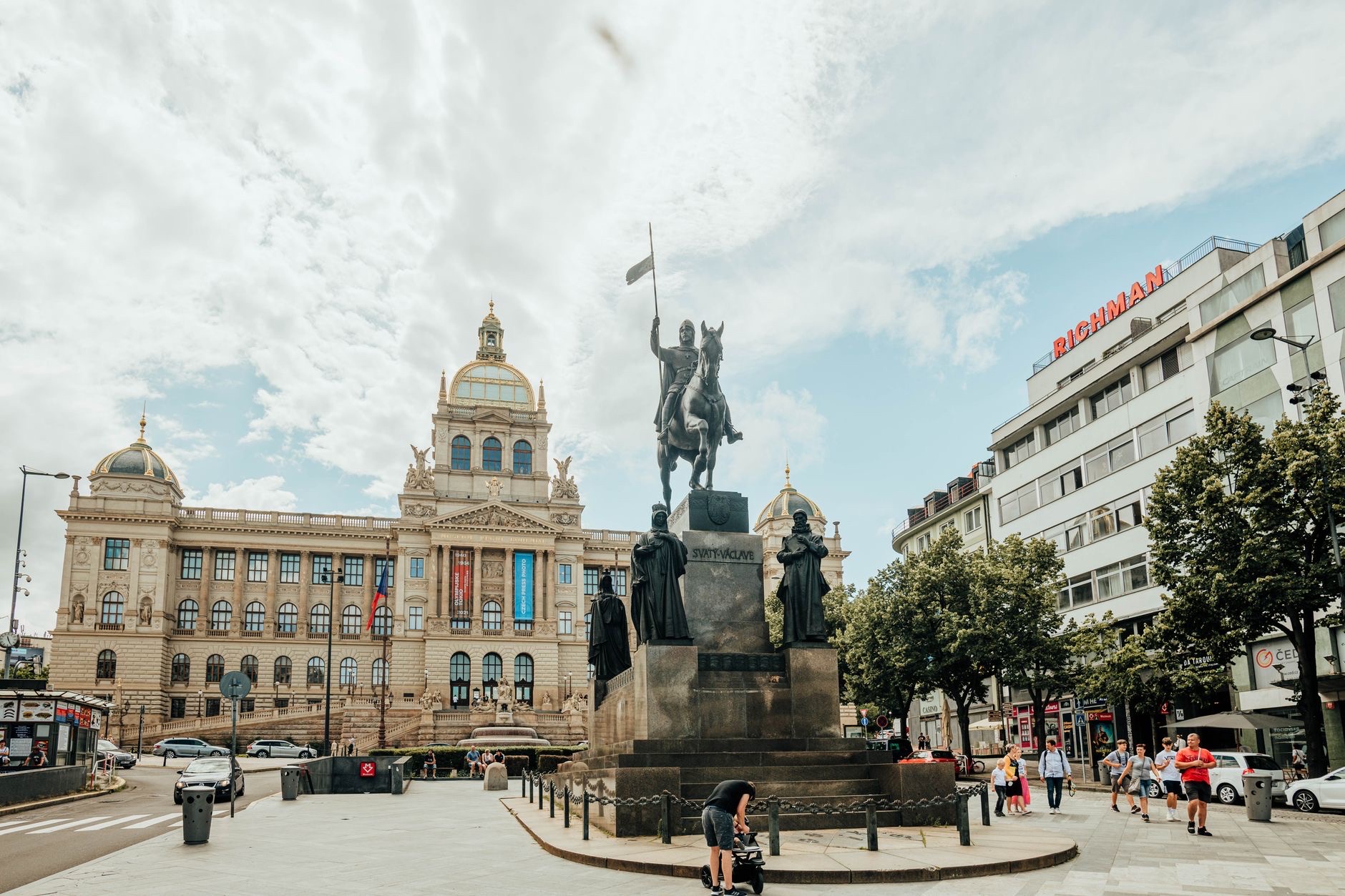
Saint Wenceslas is more than a statue and a day off. Discover the prince, his faith, and his murder in Stará Boleslav, plus how to walk his story as a Treasure Hunt.The statue of the rider with a banner is familiar to anyone who’s walked across Wenceslas Square. But few people stop and ask who that prince actually was. Saint Wenceslas was born around 907 into the Přemyslid dynasty, and he’s still considered the main patron of the Czech lands. He ruled briefly and died violently, yet he became a symbol that has survived for centuries. His story blends politics, faith, and family betrayal. And the best part is that you can walk through it on foot, right where it happened.
The Prince and the Saint
He entered the world as a member of a family that stood at the very birth of the Czech state. His father was Prince Vratislav, his mother Drahomíra, and his grandfather Bořivoj I, the first historically documented Přemyslid prince. Young Wenceslas was raised by his grandmother, Saint Ludmila. She was the one who instilled in him the Christian faith that would shape his entire life. At a time when the country was only beginning to unify and paganism still mingled with Christianity, that wasn’t a given; it was a choice with consequences.
As a ruler, he won people over through deeds, not force. His Christian upbringing, peaceful policies, and charitable acts made him well loved among his subjects. He was deeply religious and supported the spread of Christianity, building churches and suppressing pagan customs. Not everyone liked that. Part of the nobility stayed tied to the old traditions and saw his zeal as a threat to their own power. The tension that would boil over into tragedy a few years later was already taking shape.
Legends quickly gathered around the prince. According to them, he grew grapevines and wheat himself so he could bake the hosts and prepare the wine for services. The story goes that he walked out to the fields at night to bake bread for the poor. Another tale says that during negotiations with powerful imperial lords, a shining cross appeared on his forehead, filling his opponents with awe and admiration. The point of these stories was clear: to show that his power came not just from worldly strength but was blessed by heaven itself.
Murder in Stará Boleslav
His peaceful reign ended in betrayal from his closest family. It happened on September 28, 935, in Stará Boleslav, where his own brother took his life. As the story goes, Boleslav invited him to a feast, and armed men waited for the prince at the church door. Wenceslas reportedly sensed the danger, but instead of hiding he stopped for morning Mass. He believed God’s will was stronger than any human conspiracy. On the church threshold, it cost him his life.
Why his brother reached for a weapon has been debated for centuries. Wenceslas sought peace even at the price of concessions: he recognized the dominance of the Duchy of Saxony and paid it tribute to avoid war. For Boleslav and part of the nobility, that was weakness, not wisdom. They wanted a strong, independent state, and they saw Wenceslas’s caution as humiliating. Beyond politics, religion played a role too, because Wenceslas’s fervent faith clashed with the old pagan traditions.
By murdering his brother, Boleslav gained control over the entire principality and could pursue his own vision of a strong but more aggressive state. Yet the exact circumstances of the death remain shrouded in mystery to this day. Historians argue over the year, and over whether it was a cold-blooded, premeditated murder or a quarrel that spun out of control. The truth probably lies somewhere in between, between a brother’s hunger for power and a deep disagreement over what the country should look like.
Patron of the Czech Lands
His death made Wenceslas a martyr, and the martyr quickly became a patron. Soon after his martyrdom, he came to be seen as the patron of the Czech lands. His veneration spread quickly, and he became a symbol of Czech statehood and a protector of the nation. A defeated prince paradoxically became one of the most powerful figures in Czech history.
His significance grew even further under Emperor Charles IV, who made Wenceslas a central figure of the Czech state. Ever since, the prince has been part of the foundation of how Czechs see themselves. His name is carried by the Crown of Saint Wenceslas, a Prague square, and a chapel in the cathedral. Wherever he appears, he’s shorthand for country, home, and responsibility for it.
We remember him at the end of September, on the anniversary of his death. A prince who ruled only a few years became a patron the country has returned to for generations. And that’s exactly why his story is worth knowing beyond the caption under a statue.
A Game Instead of a Textbook
Facts from a textbook fade; the experience stays. When you walk the places where the story happened, you’ll remember far better who was who and why it mattered. That’s exactly what our games are built on. Instead of memorizing, you walk, solve, and compete.
It works for families with kids and for groups of adults alike. Kids run from treasure to treasure and don’t even notice they’re learning. Adults appreciate getting to walk through the city and see it differently than from a café. History becomes a trip, not a chore. And it works as a school outing or a corporate event too, same game, just a different crew.
In His Footsteps
Our games take the story of Saint Wenceslas out of the textbook and into the streets where it actually unfolded. Your team gets a map of treasures on a phone or tablet, and at each treasure a question or task is waiting. You see the other teams on the map in real time, so there’s plenty of tension.
You can choose from three equal formats that differ mainly in how you move along the route:
Games are commonly created in both Czech and English. When the weather turns, the same game switches to indoor mode, the questions run on screen one after another, and the team sits together in one place in a hall or meeting room. Plan B is part of every booking and means a 100% guarantee that the event happens, running on the original date no matter the weather. So you can set out with peace of mind, even when the sky is threatening rain.
- Treasure Hunt: teams choose which treasures to visit and in what order; strategy decides the outcome.
- Mystery Trail: a fixed route where the right answer reveals the next treasure and a wrong one sends you to a penalty point.
- Challenge Tour: a fixed route along which teams move from one treasure to the next.
Two routes lead through Prague: Treasure Hunt Prague through the city center and Treasure Hunt Vyšehrad along the ramparts above the Vltava, where one of the princely seats stood.
Saint Wenceslas is more than a statue and a day off. It’s a story of faith, power, and family that played out in real streets, real churches, and on the road. You’ll understand it best by walking it yourself. Grab your family or a group of friends, take your phone, and set out on a Treasure Hunt through the places where Czech statehood was born. Treasures, questions, and a dash of competition turn history into a game you won’t easily forget. And if you’re planning a trip for the end of September, you won’t find a better day to follow in the prince’s footsteps.
A Living Symbol of Czech History
More than a millennium on, Saint Wenceslas remains a vibrant symbol of Czech history and spirituality - a story of faith, courage and betrayal that continues to inspire.
Interested in how this revered patron was immortalised in one of Prague’s most iconic monuments? Read Forged in Bronze - The Story of Myslbek’s Saint Wenceslas Monument. Curious about the historic twists that statue has silently witnessed? Continue with By the Horse - The Saint Wenceslas Monument as the Beating Heart of Czech History.
And to uncover more hidden gems in Prague’s historic centre with your team, try the Treasure Hunt Prague challenge.


